
Artburst Extras
Perfecto Uriel who gave dance a home in Logroño honored with Ballet Festival award

Perfecto Uriel, founder of La Casa de la Danza de Logroño, in La Rioja, Spain, and editor of the magazine “Danza en Escena,” will receive this year the “Criticism and Culture of Ballet” Lifetime Achievement Award granted by the XXIX International Ballet Festival of Miami. (Photo courtesy of La Casa de la Danza de Logroño)
Being named Perfecto—a boy’s name of Spanish origin meaning “without fault”—is not the same as being one. Still, Perfecto Uriel’s desire for perfection in preserving and promoting the heritage of dance is evident in his Casa de la Danza in Logroño, La Rioja, and in the magazine that he publishes there, “Danza en Escena.”
To recognize his work of more than two decades, the XXIX International Ballet Festival of Miami, under the direction of Eriberto Jiménez, will present him this year with the “Criticism and Culture of Ballet” Lifetime Achievement Award. The ceremony will be held at the closing gala at 5 p.m. on Sunday, Aug. 11, at The Fillmore Miami Beach at Jackie Gleason Theater.
[RELATED: Read the preview feature of the XXIX International Ballet Festival of Miami]
The first thing that can be thought of as a native of Spain who is passionate about dance is that his earliest motivation was Flamenco. This time, it was not the case.
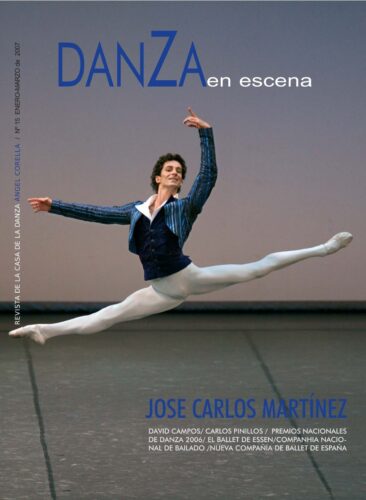
One of the first covers of the magazine “Danza en Escena,” published by the institution founded by Perfecto Uriel. (Photo courtesy of La Casa de la Danza de Logroño)
“We are talking about a long time ago, and I lived in a tiny town where it was customary to dance at festivities and on Sundays in the square,” the award-winner tells us from Logroño. “Let’s say that dance came to me from those public community dances.” That town is Torrecilla en Cameros, a village of about 500 people in the Sierra de Cameros province of La Rioja.
“I started dancing quite late,” he says, “because I came from the theater world. I got into dance through the advice of my tutors, who saw in me an aptitude for movement and led me to the world of classical dance and pantomime. I say that I never danced professionally because in England, where I studied, you could not do it before graduating, and when I graduated, I decided on mime and pantomime.”
He dedicated several years of his professional life to those disciplines and became an on-stage assistant to the Argentine mime Julio Castronuovo (1932-2013), who had settled in Madrid in 1969.
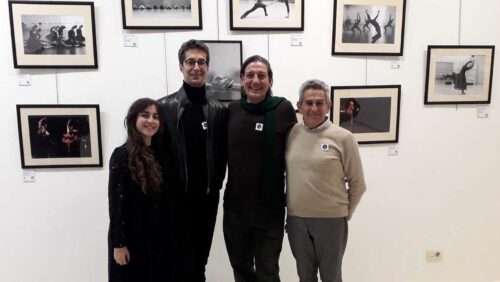
Uriel, far right, is accompanied by dancer José Carlos Martínez (with glasses), Alba Muriel, and Sergio Cardozo in the Exhibition Hall of the Logroño City Hall. (Photo courtesy of La Casa de la Danza de Logroño)
The question then is how Uriel came to the world of museology dedicated to dance.
“It’s all in life’s journey,” he answers. “My wife, María Victoria Romanos, at that time a dancer, got pregnant, and we decided to move to a small town to enjoy the baby’s growth on the way. We arrived in Logroño, and there she started working in a private dance school, and I in a theatre school. So, I decided to create something to form a local dance culture in a place where there was no professional dance activity; it was a wasteland, a desert.”
THE HOUSE OF DANCE IS BORN
Therefore, Uriel brought together “the few teachers there were” in Logroño “and the dance lovers,” with whom he created a small association and opened a space where they present and comment on dance videos.
“This is how I began to combine teaching dance and theater with the creation of La Casa de la Danza, which, after 20 years of existence, has a museum with more than 150 costumes from dancers from all over the world, a library, and a video collection,” he explains. “We have turned what was an inhospitable place for dance into, at least, a friendly space for dance.”
Hours before the conversation with Uriel, news arrived about two great artists from Spain and Cuba now based in Miami (the Flamenco dancer Estrella Morena and the ballet dancer Rosario Suárez Charín) who will individually donate some of their costumes to the collection of La Casa de la Danza.
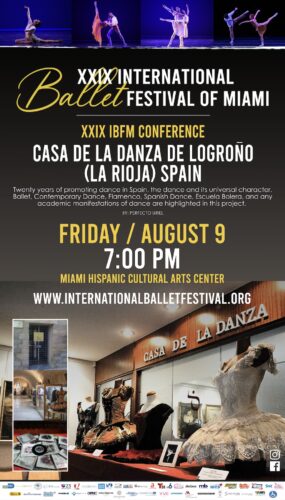
The promotional poster for Perfecto Uriel’s conference about La Casa de la Danza, which will be held on Friday, Aug. 9, at MHCAC (Photo courtesy of the XIX Miami International Ballet Festival).
“For us, it is not just great news: it is a tremendous honor,” says Uriel. “Very rarely do artists from the other side of the great ocean show themselves with such generosity. If I remember correctly, the only thing we have from that part are costumes from Pilar Rioja and from the great Ángel Pericet, whose family has always lived between Argentina and Spain.”
To deliver the donations, Moren and Charin will be present at 7 p.m. on Friday, Aug. 9, at 7 p.m. at the Miami Hispanic Cultural Arts Center (MHCAC), where Uriel will offer a conference about La Casa de la Danza.
At this point in our conversation, something very significant happened. As if it were the most obvious thing in the world, Uriel commented that the donation excited him “above all, because it comes from a very emblematic place for dance like Miami.” The times when such a statement from a European dance connoisseur would have seemed like a pipe dream are not far away.
For it to make sense today is due not only to the level reached by local dance in general but also to the existence of a recognized company like Miami City Ballet, to the founding effort of Pedro Pablo Peña (1944-2018), creator of the institution that now awards Uriel, and to the lucid and sustained critical work of Orlando Taquechel (who received this same award in 2014) promoting Miami dance from the pages of El Nuevo Herald and now with Artburst Miami.
THE ARTBURST MIAMI-DANZA EN ESCENA CONNECTION
Thanks specifically to Uriel and “Danza en Escena,” Taquechel’s reviews and the contents of www.artburstmiami.com have crossed “the great ocean” in search of the Iberian public.
Uriel found Taquechel’s reviews in Artburst Miami while reading on the Internet about what happens in the world of dance outside of Spain.
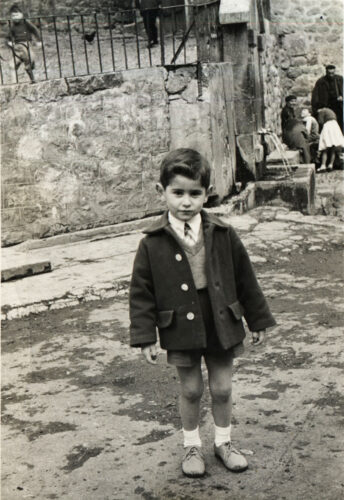
In his hometown, “there was a custom of dancing at festivities and dancing on Sundays in the square,” says Uriel, adding: “Let’s say that dance entered me from those public dances in the community.” (Photo courtesy of Perfecto Uriel).
“I wrote him an email and explained our social volunteering project because in all the activities we do at the Casa de la Danza in Logroño, nobody charges a euro,” he says. “He was grateful we thought of him and began sending an article. We have been together for several years now, and Orlando provides (for each quarterly edition) two great articles about what is happening in our Spanish-speaking community in Miami. For me, it is important to have that connection.”
Says Uriel, the response he gets from his Spanish readers is that they love to keep up to date with the performances of the Miami City Ballet, the International Ballet Festival of Miami, and what is happening on this side, both in classical and contemporary dance and, of course, Flamenco.
“In addition to being well-written, Orlando’s reviews are never hurtful toward the show, the dancers, the artists,” he says. Reading them, people learn to become more critical spectators. They are didactic, very respectful writings, even when—as we say here—they have to give a ‘capón’ (in English, a light blow to the head) because something went wrong. There is always sweetness and respect for the work done, even when it has not been as expected. It is never destructive.”
MEMORY, VOCATION AND HERITAGE
Museology is one of those professions that cultivate memory, and Uriel confesses that his desire to practice it comes from his training in England.
“The English are very conservative about their heritage; they are very fond of their artists, and I was so worried that here in Spain, we did not have a well of history for future generations,” he explains. “It is curious that, when visiting the museum, people are surprised that one of the costumes we have is that of Carmen Amaya, who everyone knows but also does not know because she has not been given the importance she deserves.”
When he established La Casa de la Danza in Logroño, his purpose, says Uriel, was to create that cultural heritage.
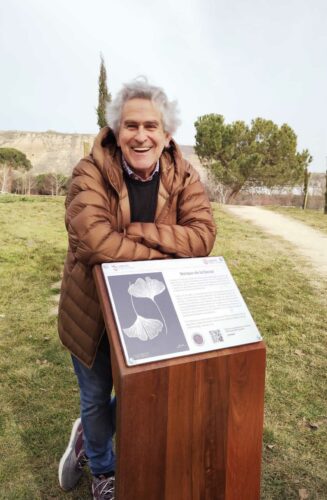
Uriel next to the plaque of the “Bosque de la Danza” (Dance Forest), created in 2009 by the Casa de la Danza de Logroño in a local urban space, where several species of trees grow, donated by artists and institutions linked to the institution. “The leaves of the Gingko Biloba resemble the silhouette of a dancer’s skirt,” can be read on the plaque. (Photo courtesy of La Casa de la Danza de Logroño)
“To turn the space into a historical reference for everything that comes from dance, where new generations would find information from the past and the present to approach the future in a different way, or with a different preparation,” says Uriel.
When asked what an editor of a dance magazine cannot lack today, Uriel barely hesitates.
“Enthusiasm, willpower, love for dance,” he answers. “It’s difficult. In 2008, seven or eight printed magazines were devoted to dance in Spain, which is ‘the great unknown’ to the public and ignored by the institutions governing the country. Those magazines were reduced by half with the crisis of 2008, and with the pandemic, they practically disappeared. Now, only two are left, and one is ‘Danza en Escena,’ which continues to be published every three months and can be found in the university catalog Dialnet (https://dialnet.unirioja.es/). Anyone dedicated to research or wanting to know more about dance and its protagonists can find what they want in “Danza en Escena.”
To tie up any loose ends, it was essential to know if that “baby who was on the way” when they decided to settle in Logroño had followed the family vocation. “She is dedicated to dance, and at the moment, she is the director of the school that her mother founded here,” says Uriel proudly, “and her name is Ana, like Pavlova.”
WHAT: Perfecto Uriel at the XXIX Miami International Ballet Festival.
WHERE: MHCAC, 111 SW 5th Ave., Miami and Jackie Gleason Theater, 1700 Washington Ave., Miami Beach
WHEN: 7 p.m., Friday, Aug. 9, conference at MHCAC; 5 p.m., Sunday, Aug. 11, closing gala at Jackie Gleason Theater.
COST: Free admission for the conference; $58 ti $92 for the Closing Gala, at internationalballetfestival.org/tickets-page-3-classical-ballet-galas
INFORMATION: internationalballetfestival.org or casadeladanza.com
ArtburstMiami.com is a nonprofit media source for the arts featuring fresh and original stories by writers dedicated to theater, dance, visual arts, film, music and more. Don’t miss a story at www.artburstmiami.com.