
Music
Powerhouse singer-songwriters Pascuala Ilabaca, La Muchacha, pair traditions with modern sensibilities

Chilean singer, songwriter, and multi-instrumentalist Pascuala Ilabaca, above, appears at the Miami Beach Bandshell on Saturday, April 5, in a double bill with La Muchacha (aka Isabel Ramírez Ocampo).
Singer-songwriters Pascuala Ilabaca, from Chile, and La Muchacha (aka Isabel Ramírez Ocampo), from Colombia, bring to the stage traditional styles and rhythms updated with elements drawn from a broad range of sources, from rap and rhythm and blues to music from India. Their lyrics, at times poetic, at times blunt like hammers, celebrate love, community, and women’s history but also jagged-edged issues such as police brutality, immigration, and sexual harassment.
Both join a long tradition of women storytellers in Latin America that includes forebears such as Violeta Parra, Mercedes Sosa, Susana Baca and the great cantadoras of Colombia, voices such as Totó La Momposina, Petrona Martínez, ad Etelvina Maldonado, all keepers of the people’s memory.

La Muchacha and her trio, El Propio Junte. From left, Camilo Bartelsman, drums; Miguel Velásquez Matijasevic, bass, and Isabel Ramirez Ocampo, vocals, guitar, are part of a double bill at the Miami Beach Bandshell on Saturday, April 5. (Photo courtesy of the artist)
Ilabaca and La Muchacha headline a double bill part of FUNDarte Out (Loud) in the Tropics annual event at the Miami Beach Bandshell at 8 p.m., Saturday April 5. The show is a co-presentacion of FUNDarte, the Rhythm Foundation, and Live Arts with the Miami Dade County Auditorium Away from home series. Count on serious messages framed by danceable music. Count on serious messages framed by danceable music.
“I like the music I make to enter through the body,” says Ilabaca, in a recent conversation in Spanish from her home in Valparaiso, Chile. “This music comes with a journey, it’s the sound of the carnivals of the Andes, so it cannot be without sweat. That’s also why the EP that I bring on this tour is called “Poética Bailable (Danceable Poetics).” The idea is to find the irresistible rhythms we have in Latin America, such as bullerengue, cumbia, or timba, and then put philosophy and poetry into it. Sweaty poetry enters better,” she says, breaking into a laugh.
Ilabaca was born in Girona, Spain, where her family had taken refuge from Pinochet’s dictatorship. On their return to Chile, her father, a visual artist, won a scholarship, and his art project involved touring all the traditional festivals in Chile in a car.

Chilean singer, songwriter, and multi-instrumentalist Pascuala Ilabaca and her six-piece group Fauna bring to the Miami Beach Bandshell “the sound of the carnivals of the Andes, so it cannot be without sweat. Sweaty poetry enters better,” she says. (Photo courtesy of the artist)
“That was my entrance to Chile,” recalls Ilabaca. “It was dazzling because . . .I discovered Chile.” From then on, she says, she has always contrasted that country “with the story of Chile … pretending to be the England of Latin America.”
That said, Ilabaca’s passion for Chilean culture and her roots is accompanied by a curiosity and openness to other cultures borne of her personal experience.
“Having this nomadic upbringing, having a craftswoman mother and an artist father, I lived in India when I was a child, and then also in Guatemala, in Mexico. The experience of growing up in a constantly changing reality and context, spending the night in the house of an Indian family or a gypsy family in the desert of Rajasthan, transformed my worldview. There was no turning back. I want to contribute something so we can open up our perspectives. That’s what excites me, communicating with the world.”

Chilean singer-songwriter Pasacuala Ilabaca brings music she calls “Poética Bailable (Danceable Poetics)” to the Miami Beach Bandshell. (Photo courtesy of the artist)
She returned several times to India to study. She has incorporated Hindi singing and concepts from Indian traditional music into her work. In keeping with her many interests, she has also written for a string quartet (for her album “Amatoria”), collaborated with (among others) the Fela Kuti-inspired Chilean group Newen Afrobeat, and is currently working on a Big Band project.
At the Miami Beach Bandshell, Ilabaca will be performing on vocals, piano, and accordion, accompanied by a sextet version of her band, Fauna, featuring congas, brass, guitar, bass, and drums.
Meanwhile, Ramírez, La Muchacha, has seen several of her songs become anthems in Colombia, including titles such as “No me toques mal (Don’t Touch Me Wrong)”, a feminist anthem that since has been embraced by children’s advocates, or “No Azara’ (which translates roughly as “No Fear”), and “El Blues De Los Tombos, (Cops’ Blues”) denouncing police brutality. Her earlier work, unvarnished, passionate, and direct, delivers blunt messages.
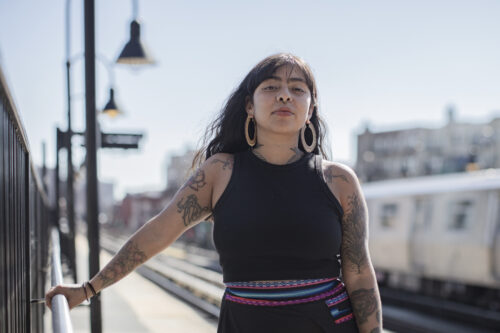
Colombian singer-songwriter La Muchacha, aka Isabel Ramírez Ocampo has seen several of her songs become anthems in Colombia. (Photo courtesy of the artist)
She titled two of her albums “Raw Songs”: “Canciones Crudas “(2020) and “Más Canciones Crudas” ( 2021).
“It has been crazy to see how these songs accompany people, make visible, and amplify things. But it is painful, to be honest,” she says in an interview in Spanish from Colombia. But then, sometimes, the audience and the context reframe the hard messages and give songs a new life, she says. “‘No Me Toques Mal’ has become a song people dance to, and I enjoy singing it because it now has a different fire, which comes not only from the wound but from us saying, ‘I am here, and I’m saying ‘No Más.’ (No More).’ ”
Many of her songs touch a nerve, and while necessary, sometimes it can get too painful. “I’ve had people telling me, ‘Right now I can’t listen to your music because I’m in so much pain. I can’t stand it,” she says. “We have to be very careful not to fall into a vicious circle of pain as we stick our finger into the wound. I feel it is also important to talk about hope about things that are weighing us down.”
“La Muchacha” is a term often used in Latin America when referring to domestic help. She says she was not making a statement when she chose the name of her alter ego. In fact, originally, it was going to be Muchacha Pájaro (Bird girl). “It was later, when I checked the etymology, that I realized how strong (the choice) was. Then I saw the reflection between the girl who washes the dishes and the one who breaks them. I was not the girl who followed orders, but the girl who spoke up, who says what needs to be said — even if she liked doing the dishes too.”
Accompanied by El Propio Junte, a trio featuring Miguel Velásquez Matijasevic on bass and Camilo Bartelsman on drums, and percussion, Ramírez will be playing some of her best-known material but also presenting music from her most recent release “Los Ombligos, (The Navels)”, in which she brings together a social long view and personal stories.
“I have songs that mobilize spaces of anger, of pain. I’ve had people telling me, ‘Right now I can’t listen to your music because I’m in so much pain. I can’t stand it.’ ”

From left, Isabel Ramirez Ocampo, vocals, guitar; Miguel Velásquez Matijasevic, bass; Camilo Bartelsman, drums. La Muchacha and her trio, El Propio Junte.“ (Photo courtesy of the artist)
She earnestly says that she “needs to make ‘ointment songs,´ ‘mattress songs,’ and ‘little cloud songs.’ They don’t have to be all in pink and romantic, but we need to realize that we can talk about other things.”
Ilabaca and Ramírez are bold print names in a generation of women singers and songwriters in Latin America leading the way with their new folk fusion and their messages. But if we are surprised, we probably haven’t been paying attention, suggests Ramírez.
“We have always been here. What has happened is that we have had so many centuries of being invisible, of repression, . . . biases that, obviously, there is a historical gap in which many of these things never came to light,” she says. “But women have always been doing things. Always.”
WHAT: FUNDarte in collaboration with the Rhythm Foundation and Live Arts with Miami Dade County Auditorium Away home series presents La Muchacha and El Propio Junte and Pascuala Ilabaca & Fauna as part of Out (Loud) in the Tropics 2025
WHERE: Miami Beach Bandshell, 7275 Collins Ave, Miami Beach, FL 33141
WHEN: 8 p.m., Saturday, April 5
TICKETS: $40.69 includes fee, Miami Beach Residents $35.36. $236.90 club level reserved, which includes up to 6 tickets. At Dice
INFORMATION: (786) 453-2897 or miamibeachbandshell.com
ArtburstMiami.com is a nonprofit media source for the arts featuring fresh and original stories by writers dedicated to theater, dance, visual arts, film, music and more. Don’t miss a story at www.artburstmiami.com.